
Concordance studies estimate how scores from two different tests compare to each other when they measure similar constructs—in this case, academic English language proficiency. They allow institutions to answer questions such as, “If I typically require a TOEFL score of 90, what DET score is most comparable?”
When a language test changes how it reports scores, admissions teams need to know what it means for their policies. To maintain comparable requirements across accepted tests, they must understand how one test’s new score scale maps to other tests’ score scales, and whether the change means they must revisit requirements for all of the tests they accept.
In this post, we’ll recap what our DET–TOEFL concordance represents, explain what TOEFL’s new score reporting means for our existing concordance, and highlight other resources—like our DET–IELTS concordance and CEFR alignment—that can support evidence-based score setting.
How do DET scores compare to TOEFL scores?
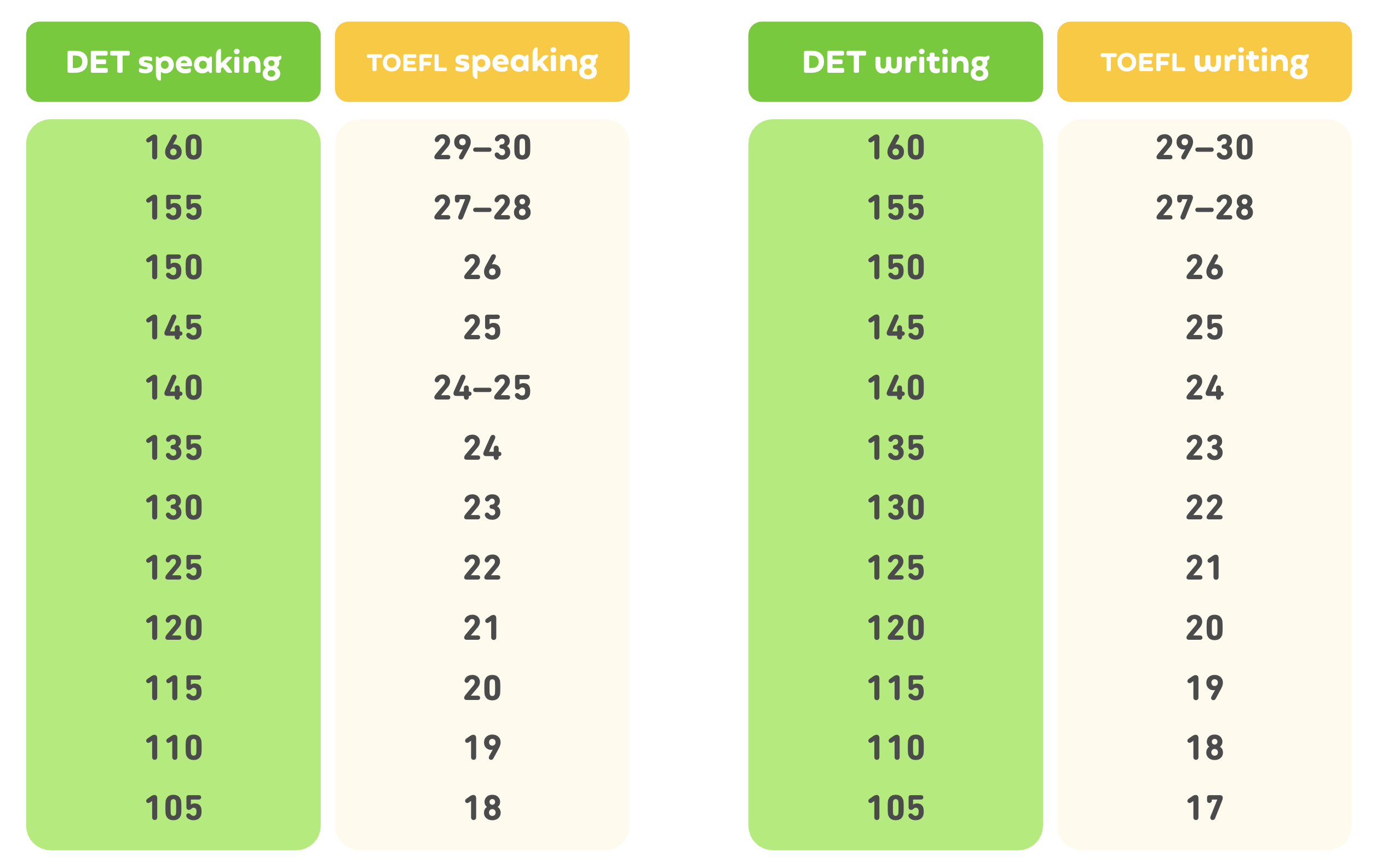
In our DET–TOEFL concordance research, we analyzed data from test takers who had taken both tests within three months of each other. This work showed strong relationships between DET and TOEFL scores, providing concurrent validity evidence that, despite differences in format and design, the tests measure highly related constructs. This research produced the concordance tables that appear on our Scores page.
When will the DET–TOEFL concordance be updated?
In early 2026, TOEFL iBT introduced a new 1–6 score scale for reporting results, in addition to other test changes. Since this change, some institutions have asked whether the DET will immediately “re-align” its concordance with TOEFL. In the near term, the existing DET–TOEFL concordance will remain our recommended reference.
The current concordance is based on TOEFL iBT total scores reported on the 0–120 scale. ETS will report TOEFL total scores on the 0–120 scale alongside the new 1–6 scale for two years, indicating that scores from the new TOEFL are intended to be comparable to those from the previous version. Institutions may consider, based on the evidence ETS provides, whether the updated TOEFL aligns closely enough with the prior version for their decision-making needs.
In that context, continued use of the DET–TOEFL concordance tables (developed using data from the previous TOEFL version) involves treating the two most recent TOEFL versions as comparable for score interpretation purposes. Because the 0–120 total score remains available, institutions can continue to use the published DET–TOEFL concordance to map DET scores to TOEFL scores on the 0–120 scale. Institutions should refer to ETS guidance for how those 0–120 scores correspond to the new 1–6 scale.
We will continue monitoring the DET–TOEFL score relationships to determine if and when a concordance update is warranted.
What this means for institutional score requirements
If your institution currently uses both DET and TOEFL and is revisiting policies in light of TOEFL’s scale change, you do not need to change your DET score requirements because TOEFL changed its reporting scale. The meaning of DET scores is unchanged.
If you wish to crosswalk DET and the new TOEFL 1–6 scores, we recommend:
- Using the published DET–TOEFL concordance to map DET scores to TOEFL 0–120 (or 0–30 for subscores),
- Applying ETS’s official guidance to interpret how those 0–120 scores correspond to the new 1–6 categories, and
- Using other DET resources (e.g., our CEFR alignment) to triangulate score interpretations.
In short: treat DET as the stable reference point. TOEFL has changed; DET’s scale and score meaning have not.
DET–IELTS concordance and CEFR alignment
If your institution is taking this opportunity to revisit language test requirements more broadly, it can be helpful to look beyond TOEFL and consider all of the tests you accept. The DET provides two additional resources that can support comparable, defensible score policies across tests: the DET–IELTS concordance and the DET–CEFR alignment.
Our concordance studies of the DET with IELTS Academic used large samples of official score reports (3,586 in total) and best-practice equating methods to map DET scores to the IELTS 1–9 scale, including both the overall score and Individual Subscores. Additionally, an independent alignment study using a panel of experts in applied linguistics linked DET scores to the Common European Framework of Reference (CEFR), supporting the use of DET within broader institutional or national proficiency frameworks.
Together, these resources mean that if you accept the DET alongside other tests and/or utilize the CEFR to inform score requirements, you can use the DET concordances and alignment studies as a coherent framework for checking whether your minimum scores are broadly comparable across tests.
Our ongoing commitment to supporting institutions
Duolingo will continue to collect data on DET–TOEFL score relationships and to be transparent about our methods in any future concordance update. Our goal is to offer practical guidance, not just tables, by helping institutions view concordance as one tool among many—to be used alongside CEFR alignment and predictive validity studies when establishing and reviewing score policies.
In the meantime, while DET score meanings have not changed (so it’s not strictly necessary to revise DET score requirements), it remains good practice to periodically revisit score requirements and make adjustments as needed based on evidence—for example, student outcomes data.
The core message is simple: TOEFL’s new 1–6 scale does not impact the meaning of DET scores. The current DET–TOEFL, DET–IELTS concordances, and CEFR alignment remain the most defensible, evidence-based tools for setting your English proficiency requirements across different tests. As we receive new data following the TOEFL scale change, we will conduct further research and share any necessary updates or policy recommendations with clear, institution-focused guidance.
See these resources for more methodological detail:
Score comparison tables FAQ
DET Technical Manual
Our peer-reviewed article, Practical considerations for building concordances between English tests, published in the journal Language Testing
Frequently asked questions
What is a concordance study in language testing?
A concordance study estimates how scores from two different tests compare when they measure similar constructs. In this case, the DET–TOEFL concordance shows how Duolingo English Test scores align with TOEFL iBT scores for academic English proficiency.
Does TOEFL’s new 1–6 scale change the DET–TOEFL concordance?
No. The existing DET–TOEFL concordance is based on TOEFL iBT scores reported on the 0–120 scale, which ETS continues to report alongside the new 1–6 scale. Because the underlying 0–120 scores remain available, institutions can continue using the published concordance tables.
Do institutions need to change their DET score requirements because TOEFL updated its scale?
No. TOEFL’s reporting change does not alter the meaning of DET scores. Institutions do not need to revise DET score requirements solely because TOEFL introduced a new 1–6 scale.
How should institutions map DET scores to TOEFL’s new 1–6 scale?
Institutions can first use the published DET–TOEFL concordance to map DET scores to TOEFL 0–120 scores. They can then refer to ETS guidance to understand how those 0–120 scores correspond to the new 1–6 categories.
What other resources support comparable English proficiency requirements across tests?
In addition to the DET–TOEFL concordance, institutions can use the DET–IELTS concordance and the DET–CEFR alignment study. Together, these resources help ensure score requirements remain consistent and defensible across multiple English proficiency tests.
Will the DET–TOEFL concordance be updated?
Duolingo continues to monitor DET–TOEFL score relationships. If new evidence indicates that an update is warranted, Duolingo will conduct additional research and provide transparent, institution-focused guidance.