
Does how someone performs on the writing section of an English proficiency test tell you anything about how they’ll write once they’re at university? Institutions and language testing researchers have asked us this about the Duolingo English Test in particular, because its writing section looks different from most: more tasks, each shorter than a typical essay task, all scored by automated scoring models rather than by human raters.
Questions such as these can be answered through predictive validity research. When universities evaluate an applicant's English proficiency test scores, they're trusting that those scores reflect the prospective student's readiness for academic work, including the writing they'll do once enrolled. Predictive validity research is what builds that trust: it tells us how well test takers' performance on a test predicts their academic success at university. A growing body of research supports that trust for the Duolingo English Test's overall score: DET test takers perform comparably to students admitted with IELTS or TOEFL scores across a range of academic outcomes.
Most predictive validity research, including our own, has focused on the overall score. That gives us the big picture, but there's much less research on how subskill-level proficiency relates to academic success. Our research team set out to explore how DET writing performance relates to real-world academic outcomes using transcript data from real DET test takers.
What does predictive validity tell us about academic success?
Predictive validity research asks a simple question with a complicated answer: how well does a test score predict a student's future academic performance, typically measured with grade point average (GPA)? Across the field and our own prior work (including studies finding that DET scores predict GPA about as well as IELTS and TOEFL), correlations tend to fall in the modest rather than the strong range.
This is to be expected, and for two main reasons. First, predictive validity studies are necessarily conducted on students who were already admitted and enrolled; this group’s test scores (and, indirectly, GPAs) are less variable than those of the full pool of everyone who applied. Statisticians call this range restriction: a narrower range of scores in the group being studied shrinks the correlations we can observe, relative to the true relationship in a broader population. It's a feature of how these studies can be run in practice, not evidence of a weak correlation between language proficiency and academic performance.
Add to that a second reality we've written about before: language proficiency is one of many factors that shape a student's GPA, alongside things like motivation, prior academic preparation, and social and financial support. With that context in mind, here's what we found when we looked specifically at writing.
How we studied DET writing scores and university performance
This is an exploratory study that investigated two research questions:
- How are DET writing grades associated with cumulative first-year GPA?
- How are DET writing grades associated with grades in first-year writing courses?
One important caveat shapes these results. The DET sessions in this sample were completed between May 2022 and April 2024, before Interactive Writing was added, before the DET began reporting a Writing subscore. Because a Writing subscore did not yet exist, we calculated a composite writing grade for each test taker. This grade combined scores across individual writing task types using weighted averages, making it conceptually similar to, but not identical to, today’s Writing subscore.
The full set of DET task types was included: two prompt-based writing tasks (a single written prompt, answered in writing), three Picture Description (Writing) tasks, and, for test takers who saw it, the written summarization portion of Interactive Listening. (See the Evolution of the DET report for more on how the test's writing tasks have changed over time.) As a result, this composite grade isn’t strictly comparable to today’s Writing subscore. That mismatch is the main reason we're treating this study as exploratory. Our research team continues to collect data from test takers with a Writing subscore to produce a more directly comparable analysis.
We analyzed data from the DET's ongoing transcript collection study, in which test takers voluntarily share their post-secondary transcripts. The sample included 444 test takers: 140 US undergraduates, 148 US graduate students, 84 Canadian undergraduates, and 72 Canadian graduate students. Among undergraduates, 139 had also taken at least one first-year writing course for a grade (98 in the US, 41 in Canada).
Below, we report results for the composite grade first, then call out individual task types where they showed a notably different or especially strong pattern. (All correlations reported here are Spearman correlations.)
Do DET writing scores predict first-year university GPA?
Across every subgroup we examined, composite writing grades were positively associated with cumulative first-year GPA. The direction of the relationship held for both US and Canadian undergraduate and graduate students, while the strength of that relationship varied:
- Among US undergraduates (n = 140), the composite writing grade correlated with GPA at r = .27. This is modest but consistent with typical findings in language testing predictive validity research. Individual task types told a similar story, with a prompt-based writing task showing the strongest relationship of any measure for this subgroup (r = .33).
- Among Canadian undergraduates and graduate students, the composite correlated at r = .19 (undergraduates, n = 84) and r = .20 (graduate students, n = 72). This is similar in size to the US undergraduate estimate, but not statistically significant at these smaller samples. With samples of only 72 and 84, that likely reflects limited statistical power rather than a true difference from the US undergraduate estimates.
- Among US graduate students (n = 148), the composite correlated at just r = .07, and no individual task type reached significance.
We ran a regression analysis, controlling for region, major, gender, age, and self-reported confidence in non-language skills alongside the composite writing grade. Results varied. The composite writing grade added the most independent explanatory power for Canadian undergraduates (an additional 4% of variance in GPA). For U.S. undergraduates, the correlation between writing grades and GPA was strongest on its own, but the writing grade’s independent contribution shrank once we controlled for the other variables. This reduction likely reflects the overlap captured by non-language confidence and is consistent with the idea that academic success depends on multiple factors.
The US and Canadian samples likely differ from each other in other ways (in major mix and grading norms, for instance), which may contribute to the diverging patterns as well. For graduate students in both the US and Canada, writing grades explained comparatively little independent variance in GPA (an additional 1–2%), consistent with the smaller raw correlations described above.
| Country | Degree level | n | Writing–GPA correlation (r) | Variance explained (ΔR²) |
|---|---|---|---|---|
| US | Undergraduate | 140 | .27 | 0.6% |
| US | Graduate | 148 | .07 | 1.1% |
| Canada | Undergraduate | 84 | .19 | 4.3% |
| Canada | Graduate | 72 | .20 | 1.0% |
This overall pattern — weaker associations for graduate students than undergraduates, in both the raw correlations and the regression results — should not be read as implying that DET writing scores are less meaningful for graduate admissions.
A more plausible explanation is range restriction: Graduate applicants are typically a more homogeneous, higher-proficiency population to begin with. Many programs set higher English requirements, and applicants often bring more prior experience in English-medium contexts. A narrower range of writing ability reduces the observed correlation with GPA, even when the underlying relationship exists.
GPA also tends to be higher and less varied at the graduate level, further suppressing observed correlations. This shows up most clearly among US graduate students, who had the highest average GPA and the least GPA variation of any subgroup in our sample. This kind of ceiling effect makes it especially hard to detect a relationship with writing scores, no matter how strong that relationship actually is.
Do DET writing scores predict first-year writing-course grades?
This is the more direct test of writing's predictive validity, since first-year writing courses are as close as transcript data gets to a real-world writing outcome. These analyses were based on the undergraduate data only, since first-year writing courses are an undergraduate curricular feature.
Among undergraduates who took a first-year writing course, 75.5% of US students and 53.7% of Canadian students earned a 4.0 (the highest grade, equivalent to an "A"). That's a meaningful finding in its own right: the large majority of students admitted with a DET score went on to earn top marks in required first-year writing coursework. It also points to a considerable ceiling effect in writing-course grades. Most students cluster at the very top of the scale, which shapes the statistical approach we describe below.
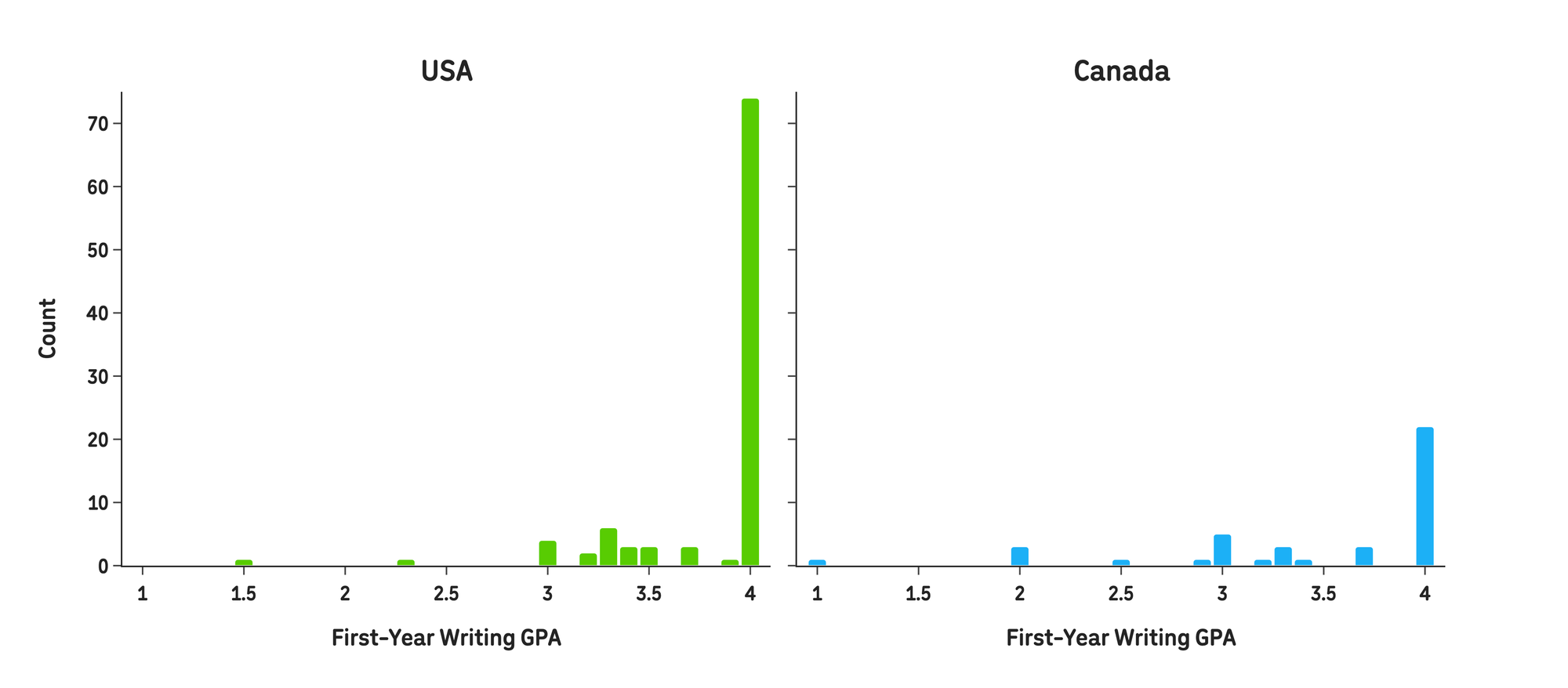
The composite writing grade was positively correlated with first-year writing-course GPA: r = .22 among US undergraduates (n = 98, statistically significant) and r = .10 among Canadian undergraduates (n = 41, not significant at this smaller sample size). Individual task types followed a similar pattern among US undergraduates: the prompt-based writing tasks and the Interactive Listening summarization task all correlated in a comparable r = .22–.24 range, while the Picture Description (Writing) task was the one measure that didn't reach significance on its own.
A separate logistic regression analysis showed that students with higher composite writing grades were meaningfully more likely to earn a 4.0 in their first-year writing course(s). A one-standard-deviation increase in the composite grade (roughly the difference between an average and a strong writing performance) corresponded to about a 37% lower probability of earning a grade below 4.0 when controlling for region, major, gender, country, and age.
What these findings mean for university admissions
For institutions, this exploratory study suggests DET writing grades (not just the overall score) carry meaningful signal about how a student is likely to perform in first-year academic writing specifically. That’s a piece of the DET's validity story that hadn't previously been examined using real academic outcomes. Overall, DET writing grades showed a consistently positive relationship with both cumulative GPA and first-year writing-course grades.
We want to be careful not to overstate these findings given the study’s exploratory nature. Because these DET sessions predate Interactive Writing and Writing-subscore reporting, these results reflect a retroactively reconstructed writing grade, not the Writing subscore currently reported. Other limitations include small sample sizes in several subgroups (particularly Canadian and writing-course-specific analyses, which limit how confidently we can estimate some effects) and a skewed distribution of writing-course grades clustered near 4.0, which limited us to correlation- and threshold-based analyses rather than linear regression models.
Our research team is continuing to collect transcript data, now focused on test takers who took the DET after Interactive Writing launched and who have a reportable Writing subscore. That relaunched study will apply the same approach to a broader base: more institutions, more graduate programs, and larger Canadian samples. It will also let us examine the current DET writing construct directly.